PE vs PVC: Why Material Matters in Artificial Plants
Walk into any trade show exhibiting artificial plants and you'll see two fundamentally different products presented side by side, often at dramatically different price points. The difference almost always comes down to one thing: whether the foliage is made from PE (polyethylene) or PVC (polyvinyl chloride).
This distinction matters more than any other specification decision when buying artificial plants for a commercial space. Here's everything you need to know.
What Is PE Foliage?
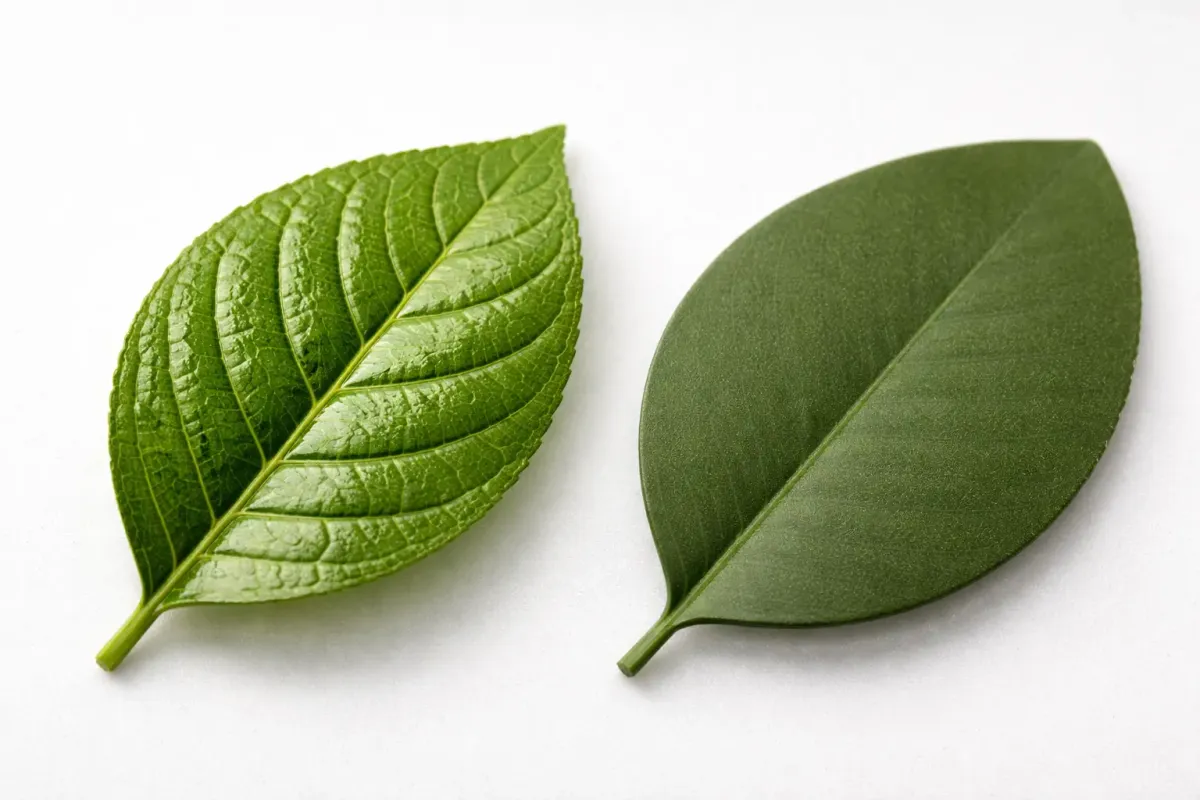
Polyethylene (PE) foliage is produced by injection-moulding softened PE compound around a real plant leaf or a precision-tooled mould derived from a real leaf. The result is a leaf that captures the exact surface texture, vein structure, edge detail, and colour variation of the natural original — because it was literally shaped around one.
PE leaves have a soft, flexible feel. They move naturally in air currents. Under close inspection — even very close inspection — the leaf structure reads as genuinely organic. When manufactured at the quality level LaySun operates at, the primary question guests ask is not "is this real?" but "what species is that?"
PE is also chemically stable, UV-resistant (when formulated correctly), and compatible with the fire-retardant additives required for NFPA 701 and EN 13501 compliance. For commercial applications, PE is the only material that delivers on all three dimensions: realism, durability, and fire safety.
What Is PVC Foliage?
Polyvinyl chloride (PVC) foliage is produced by a different process — typically extruding or cutting flat sheets of PVC into leaf shapes, then embossing surface detail. The result is a leaf that is recognisably artificial: flat, stiff, with a plastic sheen and simplified detail that doesn't survive close inspection.
PVC is cheaper to produce, which is why it dominates the residential and budget commercial market. For a home application — a decorative fern in a corner that no one examines closely — PVC may be entirely adequate. For a hotel lobby, restaurant dining room, or corporate reception area where guests and clients engage with the space at close range, PVC reads as artificial immediately.
There is also a practical concern: PVC is more difficult to fire-treat to commercial standards. Surface-applied fire-retardant sprays — common with PVC products — degrade over time and may not satisfy fire inspector requirements at annual inspection.
How to Tell the Difference at a Glance
Quick visual test for PE vs PVC foliage:
- Hold a leaf up to light: PE leaves show translucency variation across the surface, mimicking real leaf structure. PVC appears uniformly opaque or uniformly translucent.
- Feel the surface: PE has a slight waxy, organic texture. PVC is smooth, slick, or has an embossed pattern that doesn't match natural leaf grain.
- Bend a leaf: PE flexes and recovers naturally. PVC tends to be stiffer and may crease or hold a bend.
- Look at the edges: PE edges are detailed and irregular, matching the original leaf. PVC edges are often clean-cut or simplified.
- Check the colour: PE carries natural colour variation within each leaf — lighter midribs, colour gradients. PVC is typically a uniform flat colour.
What About Mixed PE/PVC Products?
Many manufacturers produce hybrid plants — a PE canopy (the visible foliage guests see) on a PVC or wire inner structure. This is a legitimate and often sensible approach: PE where realism matters, cheaper materials where they're concealed.
The key is transparency. When requesting a quote, ask specifically what proportion of foliage is PE vs PVC, and which parts of the plant use which material. A reputable supplier will answer this directly. A supplier who deflects or responds with vague quality claims is worth pressing further.
At LaySun, we specify the material composition of every product clearly and can provide samples of the actual foliage before an order is placed. For large commercial orders, we recommend requesting samples as a matter of routine — seeing the material quality in person eliminates doubt entirely.
Does Material Affect Fire Certification?
Yes — significantly. PE foliage can be fire-treated via two methods: an additive blended into the PE compound at manufacture, or a post-production surface treatment. The compound additive is far superior: it lasts the life of the product, is uniform throughout the material, and cannot be washed off or worn away.
Surface-treated PVC plants — the most common "fire-rated" option in the budget market — carry a fire treatment that degrades. Annual fire inspections may find that plants that passed inspection two years ago no longer meet the standard, requiring costly remediation or replacement.
Special-order fire-rated options for select products may use compound fire-retardant additives rather than surface sprays. Testing and documentation apply only to the specified project or order.
The Cost Reality
PE plants cost more upfront. A premium PE olive tree will typically cost 40–80% more than an equivalent PVC product from a budget supplier. For a single decorative piece in a low-traffic area, that premium may not be justified.
For commercial spaces where guests engage closely with the plants — hotel lobbies, restaurant dining rooms, spa reception areas — the calculation changes. The cost of having guests notice artificial plants is real: it undermines the environmental quality you've paid to create. The cost of replacing budget PVC plants every 3–4 years (UV degradation, cracking, fading) compounds that initial saving into a long-term liability.
PE plants installed in commercial environments typically last 8–12 years with no maintenance. The lifetime cost per year is often lower than the budget PVC alternative — quite apart from the dramatic difference in visual quality.
Every LaySun product uses premium PE foliage
Browse our full catalogue of commercial artificial trees, with special-order fire-rated options available for select products.
View Product Catalogue Our Manufacturing Process Request a Quote →