Outdoor Artificial Plants: UV Rating Guide for Terrace & Pool Installations
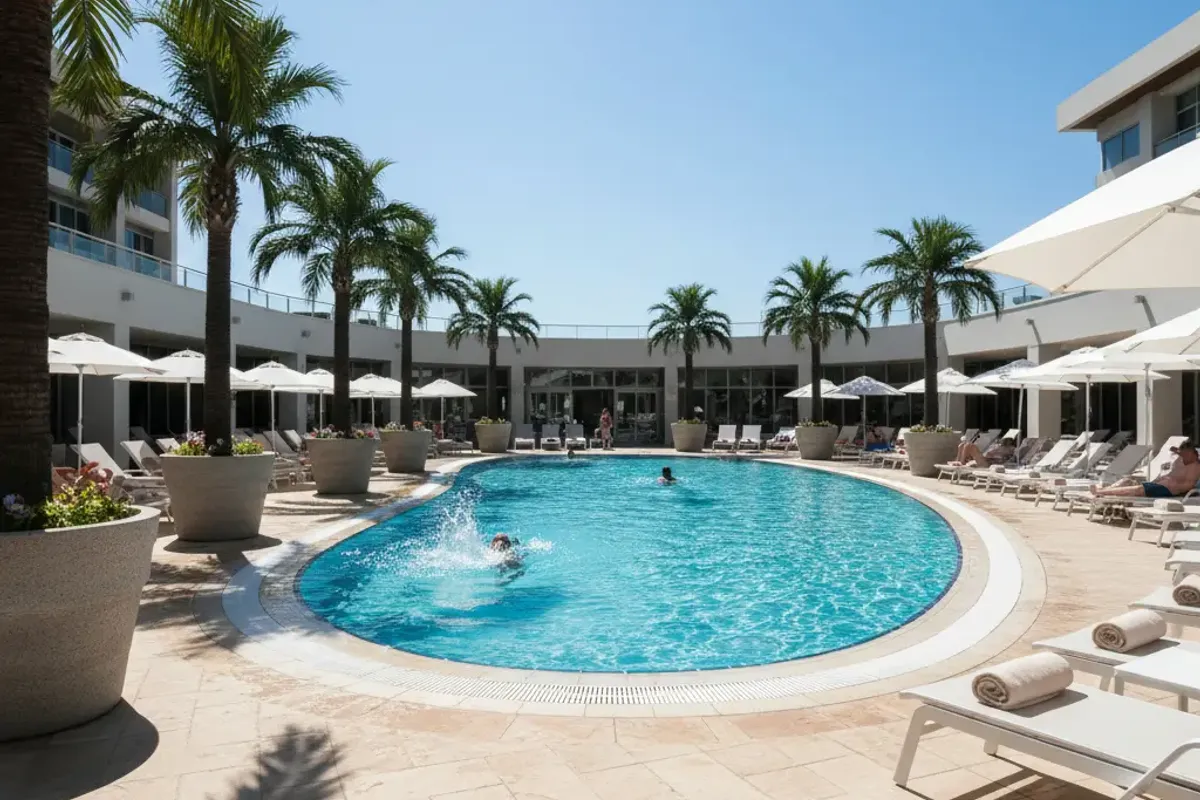
One of the most common specification mistakes we see with outdoor artificial plants is treating them as an afterthought — assuming that any artificial plant rated for outdoor use will perform adequately in any exterior environment. In practice, outdoor performance varies enormously depending on UV exposure, climate, and installation context, and the wrong product in the wrong application will show visible degradation within 12–18 months.
This guide covers what UV ratings mean in practice, what to look for in outdoor artificial plant specifications, and how to match product to application for long-term performance.
Why UV Resistance Matters More Than You Think
Indoor artificial plants and outdoor artificial plants are fundamentally different products, even when they appear visually identical. Indoor plants are formulated for ambient light levels — typically 200–500 lux in commercial interiors. Direct sunlight, even in temperate climates, delivers 10,000–100,000 lux. The UV component of that sunlight is what degrades polymer materials, causing colour fading, surface cracking, and structural brittleness over time.
Without UV-stabilised compounds in the foliage material, an artificial plant exposed to direct sun will begin to show visible colour fade within 6–12 months. By 18–24 months, the foliage will typically be brittle, discoloured, and structurally compromised. This isn't a quality failure — it's a specification failure. The product simply wasn't designed for that exposure level.
Understanding UV Ratings
UV resistance in artificial plants is typically specified in one of two ways: a UV protection factor (UPF) rating derived from textile testing standards, or a stated number of outdoor hours based on accelerated UV aging tests (often measured in xenon arc lamp hours, which simulate years of outdoor exposure).
For commercial outdoor applications, the minimum specification you should accept is:
- Full sun, tropical/desert climates (Middle East, Southeast Asia, Mediterranean summer): UV rating equivalent to 5+ years of direct exposure. Look for high-density PE with UV stabiliser additives, not surface coating.
- Full sun, temperate climates (Europe, coastal US, Australia southern states): UV rating equivalent to 4–5 years. Standard commercial outdoor grade is typically adequate.
- Partial shade, any climate: Standard outdoor grade is appropriate. Products described as "indoor/outdoor" with basic UV treatment may be acceptable for sheltered terraces or covered outdoor areas.
What Outdoor-Grade Actually Means
The term "outdoor-rated" is not regulated or standardised, which means it can mean almost anything. When evaluating a supplier's outdoor claim, ask specifically:
- Is the UV stabiliser in the material compound or applied as a surface treatment? — Compound stabilisers last the life of the product. Surface treatments wash off within months of rain exposure.
- What is the rated outdoor lifespan under direct sun? — Any reputable supplier should be able to give you a specific number of years or hours under defined conditions.
- What climate/UV index is that rating based on? — A product rated for 5 years in the UK is not automatically rated for 5 years in Dubai. UV index varies by a factor of 3–4 between temperate and equatorial locations.
- Is the stem and frame material also outdoor-rated? — Foliage UV rating is only part of the story. Stems should be UV-stabilised PE or powder-coated steel. Iron stems will rust. Cheap polymer stems will become brittle before the foliage degrades.
Species Selection for Outdoor Installations
Not all plant species are equally suited to outdoor commercial use. Based on our experience with outdoor installations across climates, the most consistently successful choices are:
Palms. Date palms, Canary Island palms, and phoenix palms are the most frequently specified outdoor artificial plants for good reason. Their robust frond structure and natural tolerance of direct sun (in the real species) translates well to artificial versions — there are fewer delicate leaf details to degrade, and the silhouette remains recognisable even as the plant ages. LaySun outdoor palms are available in heights from 6ft to 20ft for large-scale terrace and pool installations.
Bamboo and grasses. Structural grass forms hold their shape well outdoors and are forgiving of UV exposure compared to broad-leaf species. Bamboo screening panels in particular are a practical outdoor solution for terrace privacy and wind screening.
Boxwood and topiary forms. UV-stabilised PE boxwood spheres, spirals, and hedging panels have become standard in high-end outdoor hospitality. The dense foliage structure is resilient to wind and UV, and the formal shape maintains its definition without the pruning required of live equivalents.
Tropical broad-leaf species (monstera, bird of paradise). These require careful specification outdoors. Large, flat leaf surfaces accumulate UV exposure and are among the first to show fading in tropical climates. Specify only compound-UV-stabilised versions and expect a shorter replacement cycle than with palms or structural grasses.
Vessel and Anchoring Considerations
Outdoor installations require specific attention to vessel specification and anchoring. Standard indoor ceramic or lightweight resin planters are not suitable — they will crack under thermal cycling (the expansion and contraction caused by temperature variation) and may tip in wind loading.
For outdoor terrace and pool installations, we recommend:
- Fibreglass or rotomoulded PE planters for general outdoor use — lightweight, UV-stable, and thermally stable
- Concrete or aggregate-filled bases for tall specimens (8ft+) that require ballast against wind loading
- Drainage holes or base platforms to prevent water pooling, which accelerates stem and frame degradation
- Stainless steel or hot-dip galvanised internal frames for specimens installed in coastal environments where salt air accelerates corrosion
When requesting a quote for an outdoor installation, include your location, the installation type (covered terrace, open rooftop, pool surround), and any known wind or salt exposure. We'll specify the right product and vessel combination for your conditions — including written guidance on expected replacement cycles for your climate.
LaySun outdoor products carry a minimum 3-year UV warranty for temperate climate installations and are available with extended specifications for tropical and high-UV-index environments. Contact us with your project location and we'll confirm the appropriate product range.
Looking for outdoor-rated artificial plants?
LaySun's outdoor range is UV-stabilised and tested for commercial terrace, pool, and exterior installations.
View Product Catalogue Explore Systems Request a Quote →